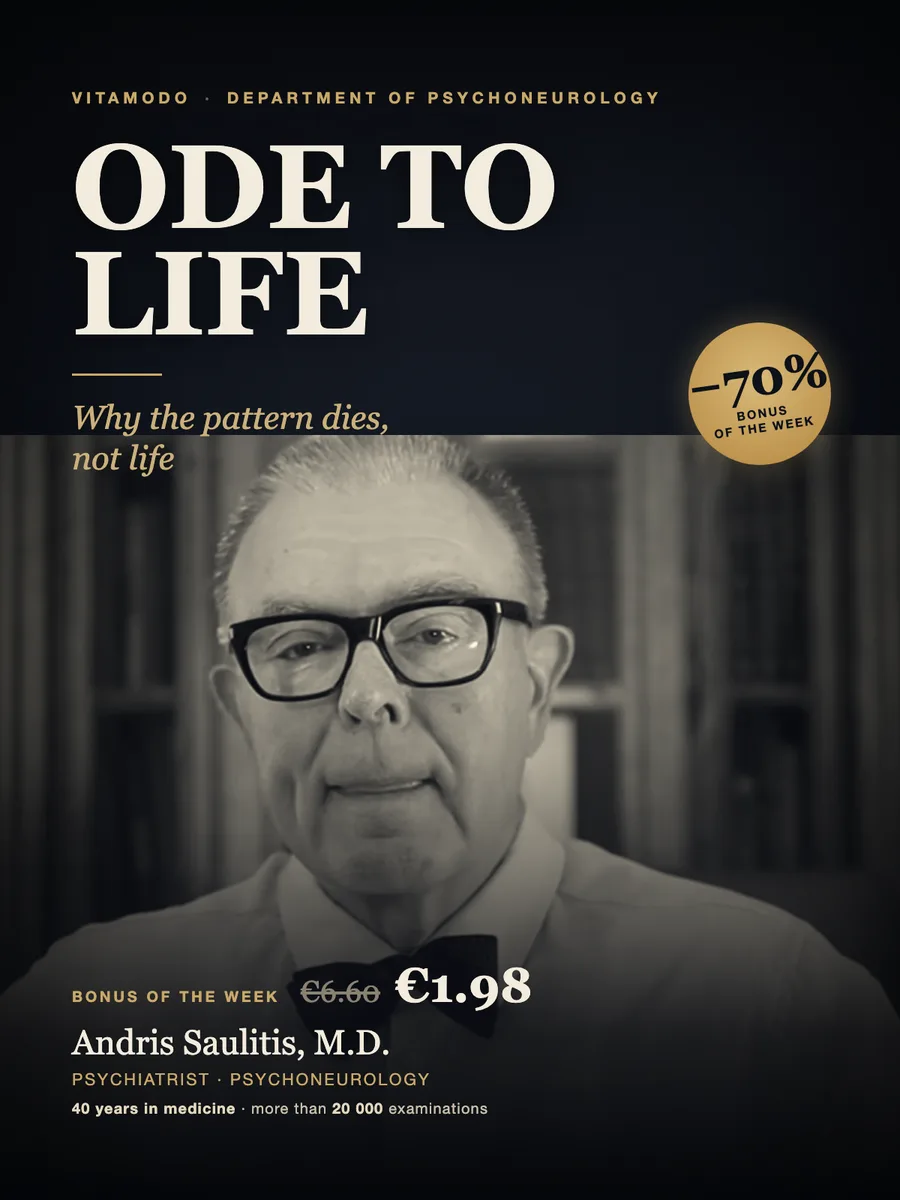
ODE TO LIFE
A physician on why it is the pattern that dies, not life
Andris Saulitis, M.D. · psychiatrist · more than 40 years at the human bedside
This book is a compass, not a sermon. I write it as a clinician who spent forty years watching a person break and rise again — and drew from it not pessimism but a law of renewal. Every thought I press down to an axiom and up to a conclusion fit for Monday morning. There is no filler here. There is mechanism, image, and action. Write to me personally — vitamodo.store. I answer. This book is the beginning of a conversation, not its end.
ARCHITECTURE (the skeleton)
Five parts follow one logic: from the body (pain) → to the brain (plasticity) → to the model (self-similarity) → to society (institutions) → to meaning (the lifting of the apocalypse). At the peaks — Vitamodo boxes: how the method turns law into practice.
Prologue. A Compass, Not a Verdict — why a physician writes an ode to life; the central thesis: renewal comes through the death of the pattern, not through the death of the living.
Foundation. Life Coming to Know Itself — the meta-axiom: at the human level evolution becomes self-knowledge, and out of this are born medicine and its crown, psychiatry. Nietzsche as forerunner ("psychologists of the future"); Bleuler, Jaspers, Jung — those who first saw how thinking breaks; the concept of schizophrenia — what it truly is and what it is not; the line leading to Vitamodo's Department of Psychoneurology. Axiom 0: to understand the psyche is not a luxury but the next step of evolution, taken at the human level.
Part I. Pain as Compass — Nietzsche by way of suffering: pain is not an enemy but a bearing; amor fati; "what does not kill me"; the Dionysian "yes." I give a person back his body as an instrument of navigation. Axiom I: pain is a direction, not a punishment.
Part II. The Law of Renewal (neuroplasticity) — old connections must die off so that a new pattern can settle; pruning is not catastrophe but the condition of growth; the phoenix and the ugly duckling as exact images of the mechanism, not fairy tales. Axiom II: to become, you must let what is outlived in you die off.
Part III. Self-Similarity as Model — one organizing principle (a dense network + accurate signaling) across all scales: synapse → person → institution → civilization. "As in the brain, so in daily life" as a model, not an identity — and therefore invulnerable. Axiom III: the health of any system is connectivity plus signal honesty.
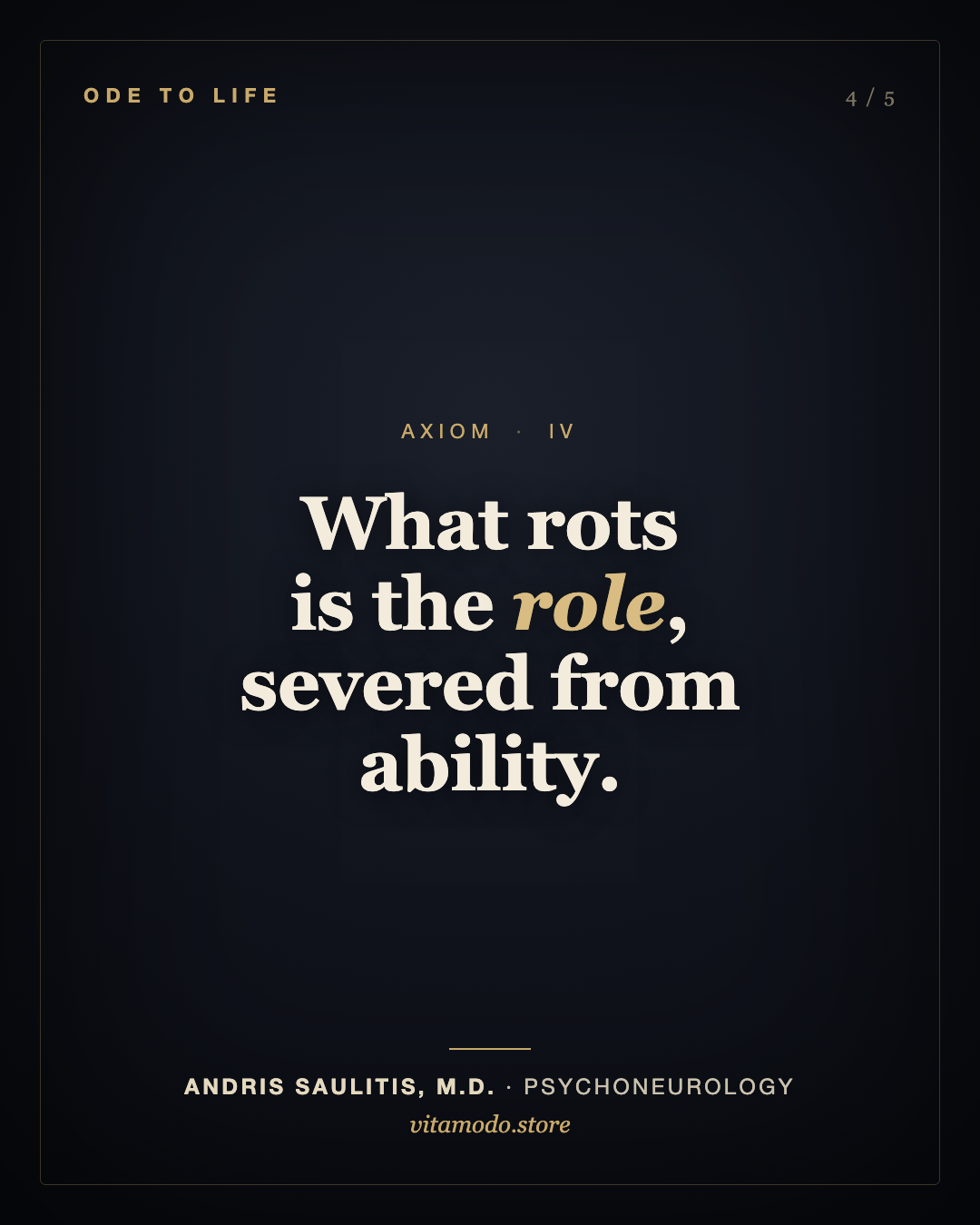
Part IV. Institutions, Not Diagnoses — collapse begins where a position is torn from ability and made hereditary. Rome, castes, extractive elites. Acemoglu–Robinson and Popper anchor this block with their authority — and no one need be declared sick to prove the thesis. Here too — the Maxim "If a part is sick, the whole is sick": society as a single organism, yet one can treat only each person individually (a personal plan), never "a part of society"; "the health of society" as a separate quantity is an illusion. Axiom IV: it is not the person and not the people that rots — it is the role, torn from ability.
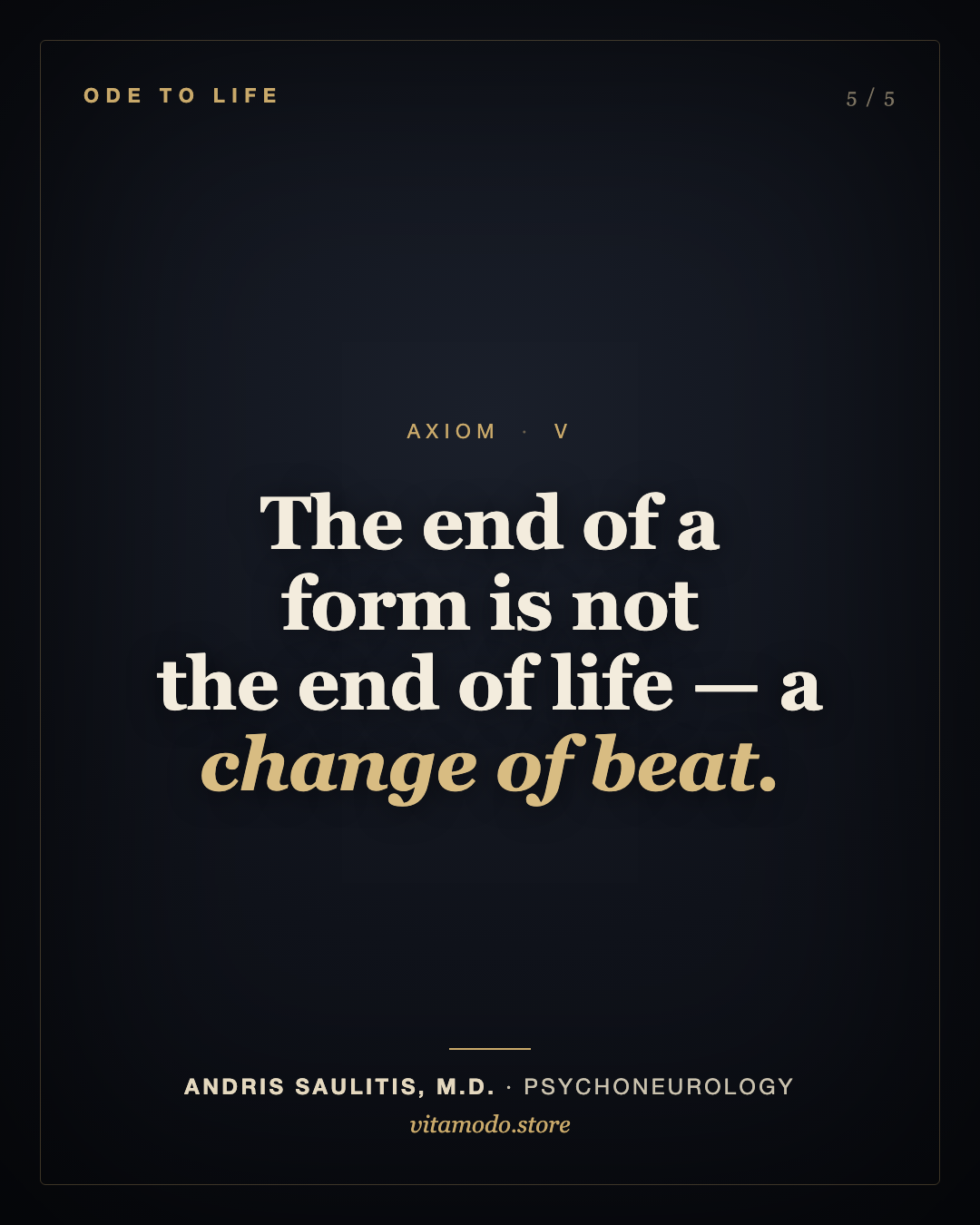
Part V. Lifting the Induced Apocalypse — pessimism as the projection of an outlived form's doom onto all that lives. It is the pattern that dies, not life. The Dionysian, the Vedic, the Bhagavad Gita as a melody in which decay is a beat, not a finale. Axiom V: the end of a form is not the end of life, but a change of its beat.
Vitamodo boxes (at the peaks of the parts): psychohygiene as daily pruning; pain-as-signal in the clinic; and — honestly, colleague to colleague — psilocybin as a therapeutic tool under investigation in controlled conditions (depression, end-of-life distress, addictions), not "merging with the universe."
Epilogue. A Creed Against Nihilism — short, firm, calling.
*At the end of every part — an invitation: write to me at vitamodo.store.*
PROLOGUE. A COMPASS, NOT A VERDICT
For forty years I sat across from people in the worst hours of their lives. And here is what I carried away — not from books, but from the eyes across the table: a person is almost never destroyed by pain. He is destroyed by the conclusion that pain means the end.
These are two different events. Pain is physiology. "I am finished" is interpretation. And the whole difference between the broken and the risen lies not in the force of the blow, but in which needle a person reads on his inner compass in that instant.
I write an ode to life as a physician, not as a preacher, because proof has accumulated in me. I have seen what should have stood collapse, and what was "bound" to perish rise. And in every such case one and the same law was at work — the law I want to unfold here to the bottom:
Renewal comes through the death of the pattern, not through the death of the living.
A connection dies — not the person. A role dies — not the people. A form dies — not life. Everything we take for "the end of the world," on closer inspection, turns out to be the end of a particular pattern that confused itself with the whole world and, as it dies, screams that the world is dying with it. This is the cry of a form, not a fact of being.
From here comes the whole book. I will lead you from the bottom up: from the body, which knows how to orient itself by pain; through the brain, which renews itself by killing its own old; through the model, by which one and the same principle holds both synapse and society; to the institutions, which rot not from "disease" but from the tearing of role from ability; and to meaning — the lifting of the induced apocalypse, toward the Dionysian and Vedic "yes" to decay as a beat, not a finale.